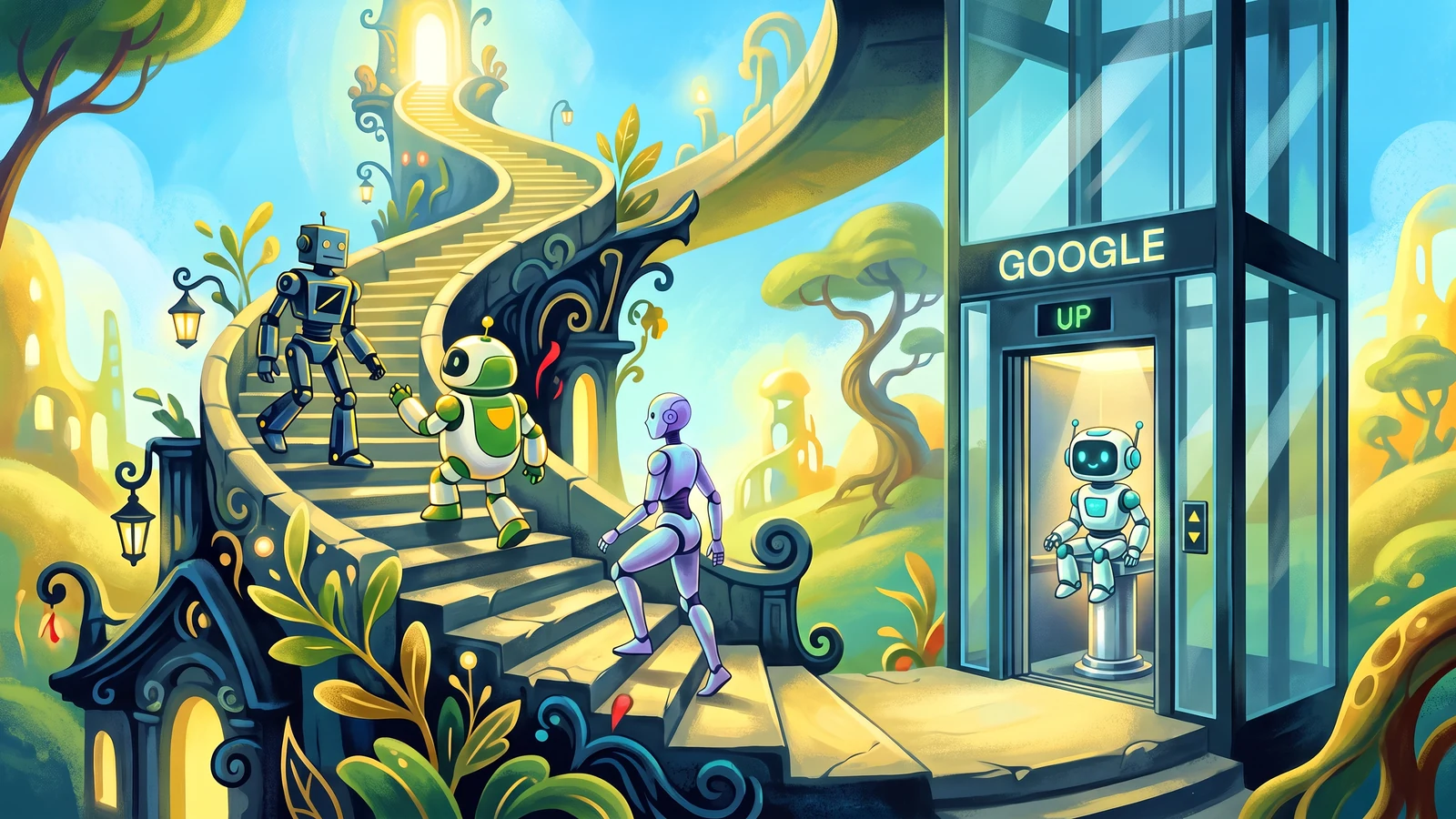
Gemini 3.1 Pro landed in February. Since then Google has shipped four Flash models, no Pro, and one laptop announcement. That order tells you what it’s actually playing for.
Count it with me.
Google released Gemini 3.1 Pro on 19 February 2026. It’s 29 August. That’s still the newest Pro-tier model you can call.
In the gap, we got 3.5 Flash, 3.6 Flash, 3.5 Flash-Lite, and 3.7 Flash. Four workhorse models in three months, the last one landing three weeks after the one before it, at half the launch price.
Fast. Cheap. Relentless. And not one of them a flagship.
Everyone else stayed in the race Google looked like it had walked out of—OpenAI, Anthropic, xAI, and the Chinese labs all kept swinging at the top of the board.
A company shipping four models in three months isn’t asleep. It’s aiming somewhere else.
The thing is I’ve been on Gemini since the Bard days. It was my first-ever AI subscription, and I’ve spent a good chunk of that time telling people Google would come out in front eventually. (I’ve said “told ya so” more than I could recall. It hasn’t aged well.)
So this isn’t a takedown. It’s me trying to work out what six empty months actually mean, because “Google fell behind” doesn’t survive ten minutes with the shipping log.
Google Said the Quiet Part in a Product Post
On 21 July, in the same post announcing 3.6 Flash, Google wrote that Gemini 3.5 Pro was “currently testing with partners” and would arrive “as soon as it’s ready.” Then, immediately after: “We have started our most ambitious pre-training run yet, for Gemini 4.”
Read that pair again. The flagship you were promised is still in partner testing, and the flagship after it is already pre-training.
Sundar Pichai had said at I/O on 19 May that 3.5 Pro was roughly a month out. That month has now happened three times, and the delay has become its own story. Axios put it flatly when 3.7 Flash shipped on 13 August: the Flash model arrived before the Pro model, while Google keeps trailing Anthropic and OpenAI at the frontier.
Now, let’s be fair for a second, because I ain’t going to sell you a conspiracy.
Google’s stated reason is capability, not strategy. The model isn’t ready. Nobody’s produced evidence of a finished flagship sitting in a drawer waiting for a launch event, and I’m not about to pretend otherwise.
But “not ready” explains the delay. It doesn’t explain the shopping list.
The Real Gap Was Never the Model
Ask a frustrated Gemini user what’s missing, and they’ll say a better Pro model. I think that’s the wrong answer, and I think Google knows it’s the wrong answer.
What Gemini has been missing is a desktop solution that does something—anything.
On Windows, what you get is the Google app—globally available since 14 April 2026, summoned with Alt + Space. It searches the web, your local files, your installed apps, and your Drive. It runs Lens on whatever’s on screen. It answers with Gemini.
Useful. But still a search bar, nonetheless.
It finds things on your PC but doesn’t do things on your PC. That’s the whole distinction, and it’s the one Claude Desktop and ChatGPT Desktop have been quietly acing for a year.
Well, here’s the annoying part. Google does ship a desktop agent on Windows. Antigravity 2.0 runs on Windows 10 and up, free, and Google’s own copy describes it as a command centre for running multiple local agents in parallel and automating routine tasks on a schedule. Everything I’ve been asking Gemini for, shipping today, on my OS.
It’s just for developers. The rest of you get a search bar.
The Mac got further. Google shipped a native Gemini app in April, and by 14 July you could tell Gemini to take action on your Mac from another device. A real capability—a step in the right direction. On par with Claude or ChatGPT? Not quite.
I Have Spark. It Still Couldn’t Connect to My Buffer
This is where I stop reading press releases and tell you what happened at my desk.
I’m on the Pro plan. I have Gemini Spark, Google’s agent layer, and Spark’s genuinely the most interesting thing Google has shipped this year. It has schedules. It has skills. Since 29 June, it accepts custom MCP server URLs, which on paper means it can talk to anything with a server behind it. On paper, that is.
I opened the Gemini app’s Connected Apps page and counted what Google hands you out of the box: fifteen, counting the whole Workspace bundle as one tile. Then I opened Spark’s own connector page and counted again. Ten.
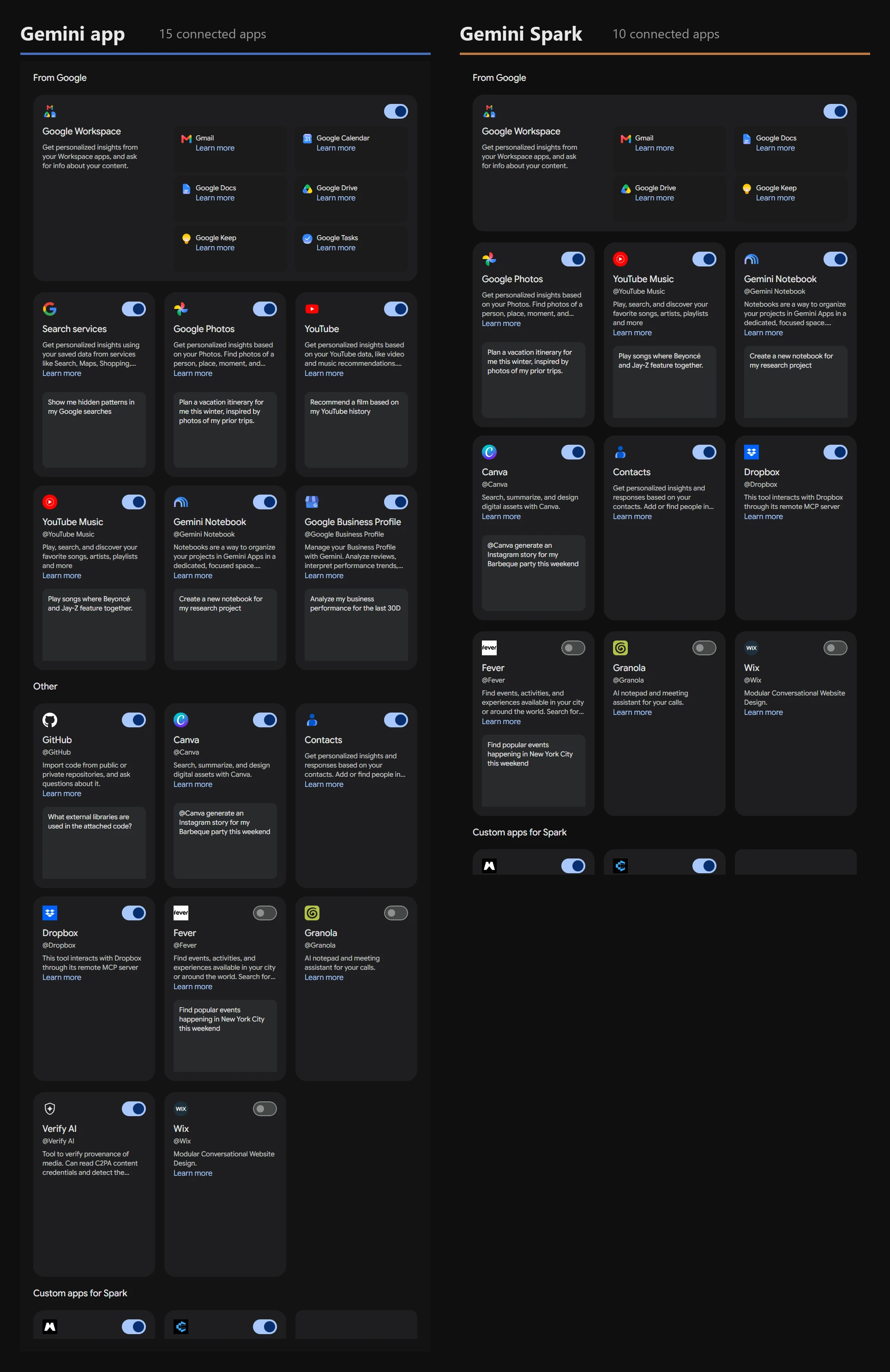
Same account, same evening, same way of counting. The Gemini app—the part that answers you—reaches fifteen services. Spark—the part that does things, the agent, the entire reason to care—reaches ten.
The inventory shrinks exactly where it needs to grow.
And I can tell you precisely what falls off the edge, because I checked the two lists against each other. Spark loses Search services. It loses YouTube. It loses Google Business Profile. It loses Verify AI. And, most shockingly, it loses GitHub.
Google’s autonomous agent—the one whose pitch is running tasks on a schedule while you sleep—cannot touch a code repository. Baffling.
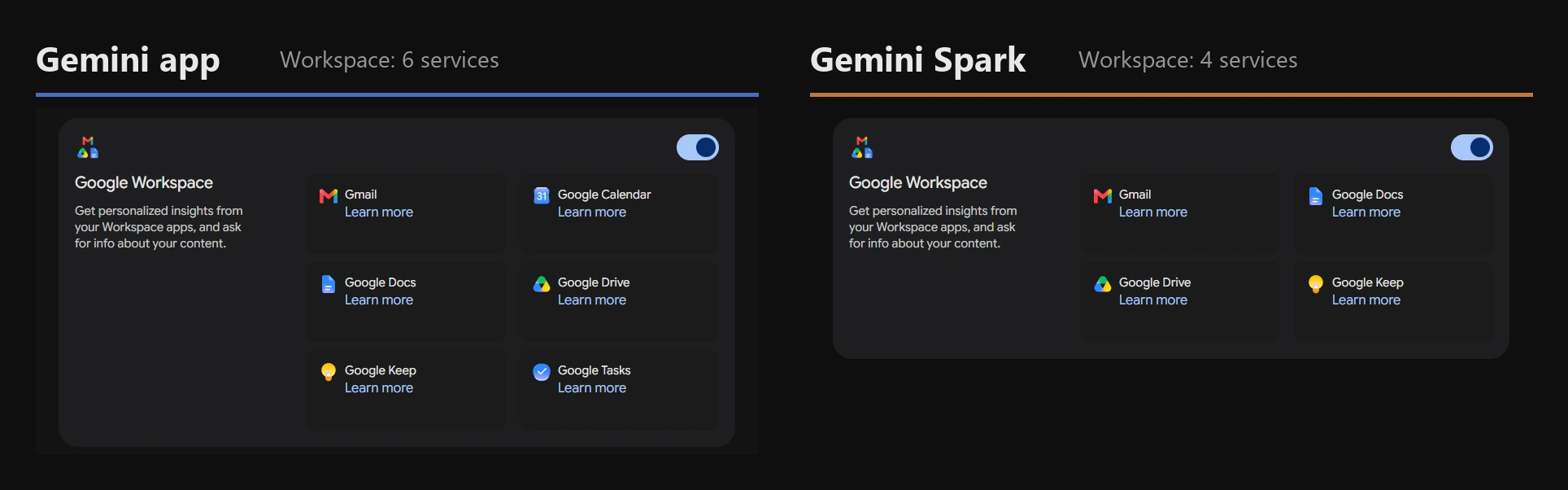
And it gets worse inside the Workspace tile. The Gemini app reaches Gmail, Calendar, Docs, Drive, Keep and Tasks. Spark reaches Gmail, Docs, Drive and Keep.
No Calendar. No Tasks.
Google built an agent whose two headline features are schedules and skills, then didn’t give it your calendar or your to-do list. I’ve read that sentence back four times and it still doesn’t improve.
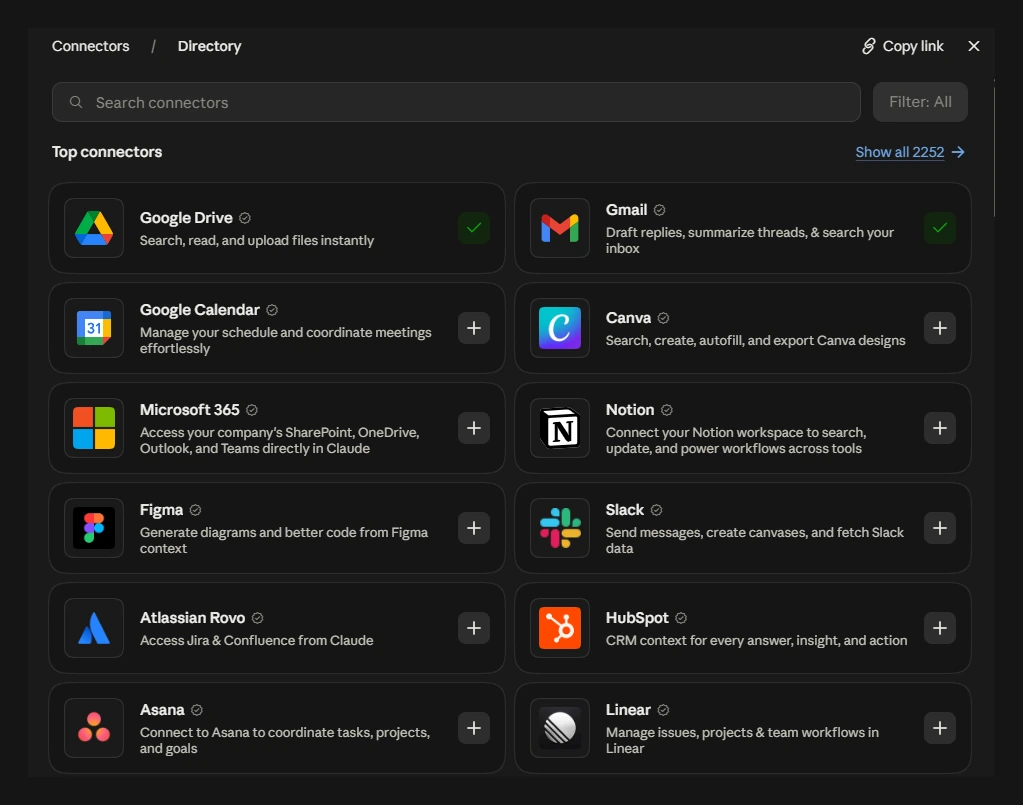
Now, I’m not dressing a hand count up as a cross-vendor benchmark, so let me kill that comparison before you make it for me. Google publishes no connector figure. Neither does OpenAI. Claude is the only one of the three that puts a number on screen, and mine offers to show me 2,252—a vendor’s published catalogue, not me counting tiles at midnight.
Ten against fifteen, though? That one’s mine against mine. Same page family, same night, same method. That comparison holds, and it’s the one that stings.
Forget the rest of the census. Here’s the part that needs no counting at all.
I pointed Spark’s custom connector at my Buffer MCP—a normal, working, unexotic server—and it wouldn’t connect. Two other custom servers sit on that same page, connected and synced, so the feature isn’t dead. It’s just shaky enough that I won’t build anything on it.
Google clearly knows MCP works, too. Its own Dropbox tile says the tool “interacts with Dropbox through its remote MCP server.” Same protocol. Google’s server holds—mine wouldn’t.
And for a product whose entire pitch is doing tasks while you’re not watching, ‘usually connects’ is the same as ‘broken.’
Ten built-ins and an escape hatch I can’t trust. That’s the gap—not the connector count.
Claude and ChatGPT let me point at an arbitrary MCP server, and it holds. Gemini lets me point, then shrugs. Even Qwen Studio—free, no card, running on the Windows machine I actually work on—reaches more of my apps (three at a time, the last I checked) than the subscription I’ve paid for since the Bard days.
I’ve written before about paying for AI tools that don’t earn their place. It stings more when it’s the one you’ve been defending for years.
The issue isn’t that Google can’t build this. It obviously can—it built the MCP support, it built Spark, and it wired in Canva, Dropbox, and Instacart over three weeks in July. The issue is that none of it behaves like a company trying to win your desktop this quarter.
I call it “connector theater”—the feature exists, ships in a changelog, and satisfies the roadmap but falls over the first time you hand it your actual work. Capability that’s real on the spec sheet and imaginary at the desk is something I’ve written about before, usually from the buyer’s side: a great tool can still be wrong for your work. This is the vendor-side version.
So why build the plumbing and then not care whether the water arrives? Well, I think it’s because the desktop it’s meant to work on hasn’t shipped yet.
Then There’s the Laptop
On 12 May, Google announced Googlebook. Not a Chromebook refresh—“a new category,” its words, not mine. Android plus Google Play plus ChromeOS, built with Acer, ASUS, Dell, HP, and Lenovo, shipping this fall.
The title on Google’s own blog post is “Introducing Googlebook, designed for Gemini Intelligence.” The product site says the same thing. Subtlety wasn’t the goal.
The line worth reading twice is inside the post: “as we are moving from an operating system to an intelligence system, we see an opportunity to rethink laptops again.” There’s a Magic Pointer built with DeepMind that wakes up when you wiggle your cursor. There’s a widget you make by prompting. There’s a glowbar, because of course there is.
Fifteen years ago Google’s answer to Windows was a browser in a box. This time it’s an assistant in a box, and the box has an OEM list.
Line the threads up.
Google can’t win the leaderboard right now and has said so in its own words. So instead it ships cheap, fast, tool-using models on a three-week cadence. It wires an agent layer with MCP support and lets it stay half-finished. It puts hardware into retail this fall with Gemini soldered into the cursor.
That isn’t a company racing you to a benchmark. That’s a company buying the doorway.
Search didn’t win in 2003 because it was the smartest engine. It won by becoming the thing sitting between you and everything else. Android didn’t win on specs. It won on being already installed.
If the pattern holds, the flagship was never the product. The flagship is a component in something that arrives with a keyboard attached.
Now Let Me Take the Leash Off
Everything above is sourced. What follows is me speculating, and I’m flagging it so you can enjoy it without mistaking it for reporting.
Because here’s what nobody’s putting together.
While the Pro tier sat empty, Google Labs kept shipping. Flow for video. Flow Music. Stitch, which turns a sketch into working front-end code. Pomelli for brand and websites. Jules for coding tasks. And Antigravity, which as of 2.0 ships a free desktop app and a CLI.
Read that last one again. Google already built an agentic desktop app that actually does things on your machine. It just built it for coders.
Meanwhile, on 31 July, Google cancelled the standalone AI Studio mobile app before it ever shipped—roughly 800,000 people had pre-ordered it, including me—and said it’s folding those app-building powers into Gemini instead. Google’s words: rather than “asking you to download yet another app,” it wants apps to “emerge naturally, in the course of your everyday conversations with Gemini.”
That ain’t a hint. That’s a stated policy of collapsing everything into one surface.
So picture the box that surface is heading for.
A Googlebook with premium hardware and a cursor that thinks. Flow and Flow Music for anything you want to see or hear. Stitch and Antigravity for anything you want to build. Jules doing the grunt work. AI Studio’s guts living inside the assistant instead of a browser tab. Spark running your errands overnight—connected, this time, to whatever you actually use. And your Android phone in your pocket, files and apps and notifications flowing between the two like they’re one device, because Google owns both ends of that cable.
Well, that ain’t a laptop. That’s the computer from Her with a Play Store attached.
And that’s the part that should make Redmond and Cupertino sit up. Google wouldn’t be going after the AI market. It’d be going after AI, apps, and the operating system in one shot—three markets nobody has ever taken simultaneously, from the company that already owns the phone in your pocket and the browser on your desktop.
Am I fantasizing? Absolutely. Some of that box may never ship, and Google’s graveyard of killed products is a genuine tourist attraction at this point.
But every piece I just listed already exists. Google built them all. They’re just scattered across a dozen tabs, three plans, and two operating systems it doesn’t control.
Give me one reason it wouldn’t put them all together in their own Googlebook.
I Could Be Completely Wrong
Let me say the quiet part about my own article: this is a prediction, not a leak. I don’t have a source inside Google. I have a shipping log, a connector page, and twenty years of watching how this company moves.
My call, dated so you can hold me to it: the flagship lands close enough to Googlebook’s launch window that the two share a stage, and the first thing Google demos on it is an agent doing something on the machine—not a benchmark chart.
Maybe 3.5 Pro slips out through the API next Tuesday with nothing attached, and this was a training problem all along. Maybe Googlebook shows up as a pretty laptop with a glowing bar and nothing behind it—in which case I’ll write that one up too, because that’d be Google fumbling the widest opening it’s had since Android.
I could be wrong. I could be right. We’ll know before the year’s out.
What I’m sure about is this: while I wait, a free Chinese app opens my files, reads my screen, and reaches more of my workspace than the subscription I’ve paid for since the Bard days. Google’s laptop had better be worth the wait. Right now the tortoise is losing to a hare that ships on Windows.
And come fall, we’ll all find out whether this was Google’s eureka moment—or its eure-what-the-heck-a moment.

Ali Arslan
Ali began his journey as a full-time Tech Journalist in 2021. He’s been a tech enthusiast all his life, starting with a 286 PC gifted to him at the age of 7.
With time, he’s grown into a power user of Android, Linux, Windows, and all things AI, which are the main focus of his writing here at Tech Unbloated. He’s also got a proficient track record for bricking (and sometimes unbricking) Android phones while trying to push the hardware and software to their limits.
Ali has an Advanced Diploma in Business Management from London, UK, and is an English Literature graduate from Punjab University, Pakistan. Other than Tech Unbloated, he’s written for big tech publications like MakeTechEasier, MakeUseOf, How-To Geek, and LimeWire—however, most of his previous work was as a ghostwriter for high-profile clients.
Before becoming a full-time writer, Ali tried his luck at music production, graphic design, teaching, business management, web development, and dropshipping. His writing often reflects all these experiences he’s had in life.
Discussion
Leave a mark
Corrections, disagreements, and the thing I missed. Comments are read before they go up.
No comments yet. Go on — be first, and make it count.
Comments stay off until you say so.
Enable comments in cookie preferences to read and join the thread. No login. No ads in the box.