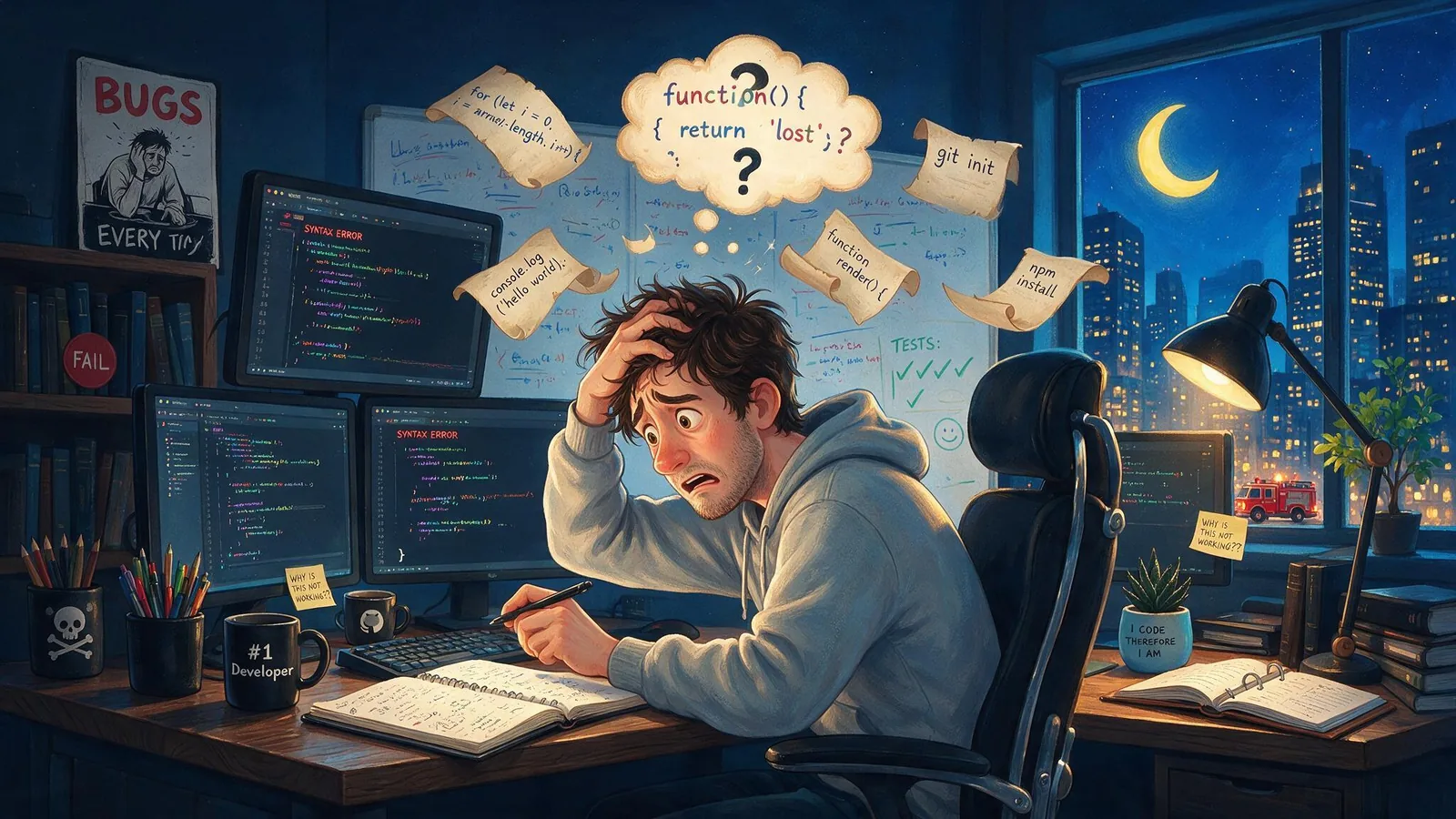
In my last post—I paid for 23 AI tools. Only 4 produced real work—I admitted to tool hoarding. Offloading is the trap sitting right next to it, and it’s sneakier.
And honestly, more worrisome.
It isn’t the apps. It’s the act of quietly handing over my skills and thinking to the apps in the name of “delegation.”
Here’s the thing—I used to feel proud when people around me got baffled seeing my AI setup. I was the guy people cornered at dinner to ask how I did it. My AI influencer side project was particularly unbelievable to them.
After going deep into the AI rabbit hole, I started exploring automations and AI agents. Then one recent day, I decided not to use AI for a few hours and do things the old-fashioned way.
I blanked on stuff that had been second nature a couple of years earlier.
It was maybe four seconds of silence. Some pretty long four seconds.
I hadn’t built a sharper version of myself. I’d built a faster version of a dumber one.
That’s the trap. Not AI, but offloading without knowing what you just gave away.
Free to Do What, Exactly?
“Offload it to AI” always gets sold as freedom. Free your brain from the boring stuff. Clear the headspace for what matters.
And look—half of that is true. Freeing yourself from first drafts, boilerplate, and scheduling is real and useful. I’m not here to talk you out of it.
But free toward what? That’s the part the pitch never gets specific about.
Higher-level thinking? Strategic work? Nobody explains the bit in the middle—the part where skipping the boring task somehow makes your actual thinking better. They just assume it does.
Most of the time, it doesn’t. The freed time doesn’t go toward something bigger. It goes toward more scrolling, more tinkering, and more “exploring the potential” of the next tool.
Same trap as last time, different costume.
You Already Know How This Works
You don’t need a study to know what happens to a muscle you stop using. Your body’s pretty blunt about it.
Your brain’s the same—it’s just quieter about the decline, so you don’t notice until you reach for something and it’s not there.
Pick anyone who’s leaned on a tool long enough. Drivers who can’t find their way around their own city without GPS. Pilots who get rusty hand-flying once autopilot does the work.
It’s the same story every time: the skill doesn’t vanish overnight. It just goes soft from never being asked to show up.
What you do fades faster than what you know. You’ll still remember that a problem exists long after you’ve lost the ability to work it through.
That’s the gap I fell into. I still knew my field. I’d just stopped doing it.
AI Multiplies What You Bring. It Can’t Hand You What You Didn’t.
This is the one idea I’d want you to walk away with, so let me put it plainly.
AI amplifies what you bring to it. It doesn’t manufacture what you left at home.
Bring a sharp brain that did the reading, and AI makes good work great. Bring nothing—because you offloaded the understanding too—and you still get work that looks great while the person behind it quietly gets worse.
The output goes up. You go down.
That’s not a glitch. That’s the whole mechanism.
If you want the receipt, an MIT Media Lab team had people write essays with an LLM, a search engine, or no tools while measuring brain activity. The LLM group showed the weakest neural connectivity. When some participants later wrote without the tool, they remained less engaged and struggled to quote their own work accurately.
It was a small, early study—54 people completed the first three sessions, and only 18 completed the fourth—and later researchers raised methodological and reproducibility concerns. So don’t treat it as gospel. But the result lines up uncomfortably well with what I felt in that four-second silence. Read the MIT study.
Find Your Floor
Now I ask myself two quick questions before I hand anything over. It takes ten seconds and saves me from a lot of slow-motion self-sabotage.
1. Is this thing actually my job?
I call it the floor. Some tasks are where your judgment is the product—the argument, the diagnosis, or the call only you can make.
Hand those off and you’re not saving time. You’re removing yourself from your own work.
2. If it’s above the floor, where’s the freed time going?
Offloading the easy stuff only counts if the time you get back goes somewhere more important.
Buying yourself room for a tougher problem? Great trade. Dodging a task because it’s annoying and then spending the slack on something equally lazy? That’s procrastination with a nicer dashboard.
Offload the doing, never the understanding.
Let AI find the broken line of code—but you’d better know why it broke. Let it pull the research together—but the call on what actually matters is yours.
The moment you let it own the understanding, you didn’t write the thing. You curated it. (Well, even curators understand what they curate.)
I use AI every single day. I just keep a hard line around the stuff that’s genuinely mine, and I do that part by hand even when I don’t have to.
Especially when I don’t have to. The friction is the work.
Comfort and Obsolescence Look the Same From the Inside
Now the cruel bit. Getting comfortable and getting replaceable feel identical while they’re happening.
The output holds steady. The effort drops. You feel productive—more productive than ever, honestly.
And you don’t notice anything’s missing until someone asks you to do the thing without the tool, and you reach for it, and it’s gone.
I was that guy. I caught it early enough, I hope. I started asking the two questions, rebuilt the floor, and made peace with doing things the harder way on purpose.
But the trap only works because it never warns you. It just feels like winning, right up until it doesn’t.
So here’s the only question that matters. Be honest about it:
Are you using AI to go further than you could on your own—or to avoid going the distance at all?
The freedom’s real. The question is what you’re doing with it.
This is part of Tech Unbloated’s AI cognition series. Start with why more productivity tools can make you less productive, then read I paid for 23 AI tools. Only 4 produced real work.

Ali Arslan
Ali began his journey as a full-time Tech Journalist in 2021. He’s been a tech enthusiast all his life, starting with a 286 PC gifted to him at the age of 7.
With time, he’s grown into a power user of Android, Linux, Windows, and all things AI, which are the main focus of his writing here at Tech Unbloated. He’s also got a proficient track record for bricking (and sometimes unbricking) Android phones while trying to push the hardware and software to their limits.
Ali has an Advanced Diploma in Business Management from London, UK, and is an English Literature graduate from Punjab University, Pakistan. Other than Tech Unbloated, he’s written for big tech publications like MakeTechEasier, MakeUseOf, How-To Geek, and LimeWire—however, most of his previous work was as a ghostwriter for high-profile clients.
Before becoming a full-time writer, Ali tried his luck at music production, graphic design, teaching, business management, web development, and dropshipping. His writing often reflects all these experiences he’s had in life.
Discussion
Leave a mark
Corrections, disagreements, and the thing I missed. Comments are read before they go up.
No comments yet. Go on — be first, and make it count.
Comments stay off until you say so.
Enable comments in cookie preferences to read and join the thread. No login. No ads in the box.